Ok, I originally thought that my most recent post belonged only on my "You know you're an adult when..." blog. But the more I think about it, the more I believe that it belongs here too.
This is me. This is who I am at this moment in time.
So, rather than duplicate it all on this blog, you can find the original posting by clicking here:
You know you're an adult when...
...you get your dream job, and then someone tells you that you've failed completely at it.
Coincidentally, two of my best friends in the world have gone through similar experiences in the past six months. It's like a virus, or the Gen X version of a (pre-mature) mid-life crisis. (Who has a mid-life crisis at the age of 32?!?) I won't say that misery loves company, because I wouldn't wish this experience on anyone. But I will say that I take courage from the fact that I'm not alone. They're both surviving, improvising, adapting, and possibly even overcoming, so I have hope that I might too.
One of my friends has a saying, "Life is hard for stupid people." That's a basic truth. Stupid people make bad decisions, which put them in difficult situations, from which they have fewer options and make even worse decisions. I've been hearing her say that for years, and the whole time, I've been smugly relying on a theory implied by the inverse of that truth, which is, "The smarter you are, the easier your life should be." And then, suddenly, the bottom dropped out of the theory, and I have been decimated to find out that being smart isn't enough. Oh, and by the way, working hard, having good intentions, and desiring to be productive and successful aren't enough either.
Life is hard.
Life is certainly not fair.
(Actually, in the grand scheme of things, that might be a good thing. "Fair" isn't all it's cracked up to be.)
...I'm not seeing any upside to the "Life is hard" thing, though...
Wednesday, March 29, 2006


Monday, March 27, 2006
You know you're an adult when...
...you get your dream job, and then someone tells you that you've failed completely at it.
NOTE: This entry was originally posted in a different blog, but after Blogger added the label feature, I decided to consolidate everything here.
WARNING: This entry isn't going to be a light-hearted as the other postings on "YKYAAW..."
I have three blogs, and they fall into three distinct categories:
Unfortunately, the subject matter at hand fits most closely into the YKYAAW category. And so, instead of some light anecdote, you're going to get a full dose of reality here. Ready?
I have worked at the same company for the past eight years. Within the first year of starting work, I knew that I wanted to be a Design Engineer in R&D, and for almost six years, I pursued that goal relentlessly. A year and a half ago, that dream came true, and I finally, officially became a Senior Design Engineer. In January, I received my first performance appraisal-- which was basically, in a nutshell, "Your performance is completely inadequate, you're on probation, and you have 90 days to convince us not to fire you." Two years ago, I got the highest rating possible (reserved for just a handful of people in the entire company) and a huge bonus. So this was a shock, to put it mildly.
Since then, I've gone through several of the 5 stages of coping with catastrophic news:
(Oh, and I also think that Humiliation, Frustration, and Overwhelming Indecision need to be added into the middle of that list as well.)
Sometimes, it feels like it takes every bit of courage I've got just to get out bed and go to work. I wake up with a headache that starts in the muscles on the sides of my skull, and by the time I swipe my badge and walk in the door to my office, I feel like I'm carrying a 25 lb lead weight in my stomach. By 10am, the headache has encompassed my entire scalp, and my throat is sore because I forget to swallow when my jaw is continuously clenched. By 4pm, I'm mentally & physically exhausted from the stress, and I still have a few more hours of work ahead of me.
I am trying to keep some sort of perspective. Certainly, things could be worse. No one in my family is sick or dying, my husband is a source of strength, and we have enough savings to survive for awhile if I do lose my job. But I've been looking, and I'm just not seeing the silver lining here, or even the light at the end of the tunnel.
I feel wounded.
Broken.
And I'm starting to wonder if courage even means what I've always thought it means. Because right now it just feels like a word that describes a lack of any better options. What are my options? Should I fight? Should I quit? Right now I don't even know which option is fighting and which one is quitting.
The thing is... it's still my dream job. I can't think of anything else that I would rather do. I love being an engineer, and I thought I was good at it. Certainly, it's a huge part of my identity, which is exactly why this ordeal has made a such deep wound that hurts all the way down to my core.
What I'm wondering now is... Will it heal? Soon? Eventually? Or do I need to cut it out like a disease and throw it away? How deep will the scars go? How long will it take for them to fade?
How obvious is it that I'm broken?
WARNING: This entry isn't going to be a light-hearted as the other postings on "YKYAAW..."
I have three blogs, and they fall into three distinct categories:
- My day-to-day blog - Also includes travel and vacation stories.
(It's now out-of-date by 2.5 vacations, but that's not really the point right now.) - Wonder - Thoughts about philosophy and religion.
- YKYAAW - This blog was originally conceived as a pseudo-ironic look at how a person occasionally (and unexpectedly) realizes that he or she is actually becoming a grown-up, even though he or she may really feel like a little kid just pretending to fit into adult society.
Unfortunately, the subject matter at hand fits most closely into the YKYAAW category. And so, instead of some light anecdote, you're going to get a full dose of reality here. Ready?
I have worked at the same company for the past eight years. Within the first year of starting work, I knew that I wanted to be a Design Engineer in R&D, and for almost six years, I pursued that goal relentlessly. A year and a half ago, that dream came true, and I finally, officially became a Senior Design Engineer. In January, I received my first performance appraisal-- which was basically, in a nutshell, "Your performance is completely inadequate, you're on probation, and you have 90 days to convince us not to fire you." Two years ago, I got the highest rating possible (reserved for just a handful of people in the entire company) and a huge bonus. So this was a shock, to put it mildly.
Since then, I've gone through several of the 5 stages of coping with catastrophic news:
- Denial & Isolation - Yep, been there, done that.
- Bargaining - I'm trying to figure out if making contingency plans for a lawsuit falls under "Bargaining" or "Denial"
- Anger - Oh, yeah, I've definitely fallen down hard right in the middle of this one.
- Depression - Plenty of this one too.
I cry...a lot. If you count the days when I break down sobbing vs. the days that I just manage to hold on by my fingernails, I'm probably averaging about 50/50.
And I'm really tired, all the time. Of course, lying awake all night thinking about work will do that to you. And even when I am asleep, I still can't escape from those thoughts-- On Saturday night, I had a very disturbing, very realistic dream about running away from my life. - Acceptance - I didn't think I was here yet, but last night I found myself filling out an application to go back to school for an entirely different career, so maybe I'm starting to dabble in this one.
(Oh, and I also think that Humiliation, Frustration, and Overwhelming Indecision need to be added into the middle of that list as well.)
Sometimes, it feels like it takes every bit of courage I've got just to get out bed and go to work. I wake up with a headache that starts in the muscles on the sides of my skull, and by the time I swipe my badge and walk in the door to my office, I feel like I'm carrying a 25 lb lead weight in my stomach. By 10am, the headache has encompassed my entire scalp, and my throat is sore because I forget to swallow when my jaw is continuously clenched. By 4pm, I'm mentally & physically exhausted from the stress, and I still have a few more hours of work ahead of me.
I am trying to keep some sort of perspective. Certainly, things could be worse. No one in my family is sick or dying, my husband is a source of strength, and we have enough savings to survive for awhile if I do lose my job. But I've been looking, and I'm just not seeing the silver lining here, or even the light at the end of the tunnel.
I feel wounded.
Broken.
And I'm starting to wonder if courage even means what I've always thought it means. Because right now it just feels like a word that describes a lack of any better options. What are my options? Should I fight? Should I quit? Right now I don't even know which option is fighting and which one is quitting.
The thing is... it's still my dream job. I can't think of anything else that I would rather do. I love being an engineer, and I thought I was good at it. Certainly, it's a huge part of my identity, which is exactly why this ordeal has made a such deep wound that hurts all the way down to my core.
What I'm wondering now is... Will it heal? Soon? Eventually? Or do I need to cut it out like a disease and throw it away? How deep will the scars go? How long will it take for them to fade?
How obvious is it that I'm broken?
Monday, October 31, 2005
You know you're an adult when...
...you buy a house.
From PV31W:
Shopping for a house is fun.
Buying a house is not fun.
Envisioning one's stuff in the purchased house is fun.
Actually moving the stuff is not fun.
Dreaming of decorating a house is fun.
Actually handing over the cash required is not fun.
Getting a paycheck is fun.
Working for the Man is, well, not so much fun...
Shopping for a house is fun.
Buying a house is not fun.
Envisioning one's stuff in the purchased house is fun.
Actually moving the stuff is not fun.
Dreaming of decorating a house is fun.
Actually handing over the cash required is not fun.
Getting a paycheck is fun.
Working for the Man is, well, not so much fun...
Wednesday, October 19, 2005
Even More on the Importance of Philosophy...
I just finished reading a short book called Light in the Shadow of Jihad. In a reference to Jefferson's great statement in the Declaration of Independence...
...this is what Ravi Zacharias has to say:
The book also includes an interesting quote from George Washington's farewell address:
We hold these truths to be [sacred] self-evident, that all men are created equal, that they are endowed by their Creator with certain inalienable rights, that among these are life, liberty, and the pursuit of happiness.
...this is what Ravi Zacharias has to say:
That one sentence sets America apart from most of the nations of the earth. Our value is not derived from government benevolence or from the mercies of democracy. Democracy and individual dignity derive from the transcendent reality of a Creator. Take away the Creator, and we are at the mercy of the powers of the moment.
This is vital to our understanding for the future. We can debate from now till the end of the world whether America is a Christian nation. The certainty is this: America was not founded on an Islamic, Hindu, or Buddhist worldview, however valuable some of their precepts might be. If we do not see this, we do not see the fundamental ideas that shaped the ethos of the American people. In that sense, bin Laden has a better understanding of us than we have of ourselves. Only within the Christian framework could a nation have been conceived that recognizes that God Himself has bestowed intrinsic dignity upon us. We are not the result of natural causes, but of a supernatural one. We are individuals with dignity in essence; and freedom, even with its risks, has been endowed upon us by our Creator.
The book also includes an interesting quote from George Washington's farewell address:
Of all the disputations and habits that lead to political prosperity, religion and morality are indispensable supports. In vain would that man claim the tribute of patriotism who should labor to subvert these great pillars of human happiness-- These finest props of duties of men and citizens... And let us with caution indulge the supposition that morality can be maintained without religion. Whatever may be conceded to the influence of refined education on the minds of peculiar structure, reason and experience, both forbid us to expect that national morality can prevail in exclusion of religious principle.
Sunday, October 16, 2005
What Has God Made Oprah Good At?
MSNBC is doing a series of articles called When Women Lead and one of the articles includes an interview with Oprah Winfrey that I thought was pretty interesting:
So, you might be asking, what is her purpose that's bigger than herself?
I think that Oprah has figured out what God has made her good at.
Success is a magnifying glass on your personality. Who you are just becomes more intense. The real beauty of having material wealth is that you don't have to worry about paying the bills and you have more energy to be concerned about the things that matter. How do I accelerate my humanity? How do I use who I am on earth for a purpose that's bigger than myself? How do I align the energy of my soul with my personality and use my personality to serve my soul? My answer always comes back to self. There is no moving up and out into the world unless you are fully acquainted with who you are. You cannot move freely, speak freely, act freely, be free —unless you are comfortable with yourself.
So, you might be asking, what is her purpose that's bigger than herself?
Right now, I'm incredibly excited about my work in South Africa. I'm going to change the future for thousands and thousands of girls because I'm going to give them an education. I'm going to go out into the villages, into the rural areas, the forgotten places, and find the girls who have the potential to excel and be leaders in the world. I'm going to create a leadership academy. I believe that the future of Africa depends upon the future of its girls and women. That's the only thing that's going to turn that continent around.
I feel blessed to have a platform that allows me to reach millions of people every day with my show and my magazine. I'm often inspired by the work we do. Recently on our show, I asked viewers to help me track down child predators. Within 48 hours, we had captured two of the men we featured. As a victim of child molestation, this was big for me and for millions of others. When you can use your voice in a way that really speaks to people, it resonates. Whether it's a school or a book or just an idea. That's what fun is. That's what living really is. Living with a capital L.
I think that Oprah has figured out what God has made her good at.
Wednesday, October 12, 2005
What Has God Made Me Good At?
Rabbi Gellman has written another great article called What God Made Us Good At, which has provided me with lots of things to ponder this evening...
Actually, fortunately for me, there are paying jobs for "good takers of things apart" and I happen to have one. I'm an engineer. I get paid to put things together, take things apart, and even to break things!
I've been there too, trapped in a job that I hated, which was literally giving me ulcers. Fortunately for me, at the same time, the rest of my life was being filled up with things that I loved-- ski patrol training, learning to SCUBA dive, and falling in love with my future husband. (And yes, I believe that God was looking out for me through all of that.)
So, as I've already said, I enjoy my job. But here's the "million-dollar" question: If I won the lottery, would I still go to work at the same job every day? In all honesty, probably not. I like the challenges though-- I like trouble-shooting, finding a root cause, analyzing data, evaluating potential solutions, and proving that everything works. (However, I'm not such a big fan of the more difficult challenges of getting out of bed early in the morning and arriving at work by 8am. Oh, and I loathe reviewing patents.) And unfortunately, it's just not the type of job that you can do as a part-time volunteer. It's more of a 40-hour-work-week-salaried-position thing. So I'm not sure what I would do.
What about you? What would you do if you won the lottery and never needed to worry about another paycheck?
Now, my other main love (after my husband & family & friends) is skiing, and not just skiing (although that, in itself, would be enough to qualify as an obsession) but ski patrolling too. I've already described some of the things that I love about skiing in a previous post, so I'll just add a couple more things that I love about ski patrolling:
But there are also things that I enjoy about patrolling specifically because it's different from my day job:
So there's two of things that I love and that I'm good at-- Engineering and Skiing. Are there others? Maybe, probably, hopefully. I love spending time with my husband and hanging out with my friends. I love reading and learning new things. And when I pause and consider that everyone on Earth has different skills and different passions, it makes me wonder what could be accomplished if more people started applying those skills to the things that they were passionate about. There's a lot of hope rolled up into that thought. How could we change our cities? How could we change our country? How could we change our world?
Instead of ending with my own rambling, I'd rather leave you with Rabbi Gellman's (far more eloquent) conclusion...
Some extraordinary adults remember what all ordinary children know: the key to life is to love what God made you good at and to do what you love.
Knowing what God made you good at has nothing to do with the job you work at to pay the rent. So when you know the secret of doing what you love, it does not necessarily mean that you will get a job doing it. There are not that many paying jobs for good listeners or good fight-enders or good takers of things apart or good bedtime-story readers or loyal friends or good feelers of the kinship of sorrow. Occasionally you can snag a job doing exactly what God made you good at-- —I thank God every day that this happened to me, but that is the life equivalent of winning the lottery. The odds on this happening are very long.
Actually, fortunately for me, there are paying jobs for "good takers of things apart" and I happen to have one. I'm an engineer. I get paid to put things together, take things apart, and even to break things!
So for those of you who feel trapped in jobs you hate, or in classes where you are being forced to study subjects you hate, take hope from this secret of life. Your schoolwork or your job or your obligations to make lunch for the kids every single day need not stop you from doing what you love today. Your life is not only your job or your grade in school, or your family obligations. Your life is fuller than that, broader than that, thicker than that, more soaring than that. Your life is doing what God made you good at. If even part of what God made you good at is used in your job, hooray, but the odds are that what you are good at spills over past your job and into your life. And no matter how crappy part of your life is, the other part, the part where you do what you love, can be glorious.
I've been there too, trapped in a job that I hated, which was literally giving me ulcers. Fortunately for me, at the same time, the rest of my life was being filled up with things that I loved-- ski patrol training, learning to SCUBA dive, and falling in love with my future husband. (And yes, I believe that God was looking out for me through all of that.)
During one of my ask-the-rabbi sessions with the fourth grade, one girl asked me, "“I don't know what God made me good at. How can I find out?"” My advice to her is my advice to you if you don't know. First, ask your parents. They know you best, though they are not always honest. They sometimes will tell you with all the love in their hearts, "“Honey, God made you good at being a sports agent."” If they tell you that, then go ask your friends. They don't know you as well as your family, but they're more honest. If family and friends do not tell you clearly what they think God made you good at, then ask yourself this question: "When am I most happy?"” The times you are most happy are the times you are doing what you love and what you love is always what God made you good at.
So, as I've already said, I enjoy my job. But here's the "million-dollar" question: If I won the lottery, would I still go to work at the same job every day? In all honesty, probably not. I like the challenges though-- I like trouble-shooting, finding a root cause, analyzing data, evaluating potential solutions, and proving that everything works. (However, I'm not such a big fan of the more difficult challenges of getting out of bed early in the morning and arriving at work by 8am. Oh, and I loathe reviewing patents.) And unfortunately, it's just not the type of job that you can do as a part-time volunteer. It's more of a 40-hour-work-week-salaried-position thing. So I'm not sure what I would do.
What about you? What would you do if you won the lottery and never needed to worry about another paycheck?
Now, my other main love (after my husband & family & friends) is skiing, and not just skiing (although that, in itself, would be enough to qualify as an obsession) but ski patrolling too. I've already described some of the things that I love about skiing in a previous post, so I'll just add a couple more things that I love about ski patrolling:
- Patrolling requires many of the same skills that I use in my particular field of engineering-- It provides lots of opportunities for problem-solving, risk analysis, and decision-making, and it requires a good understanding of how the human body is supposed to work and what can go wrong. There are lots of questions that must be answered in just a few minutes time: What is the main problem/injury? What is the worst-case scenario? How can we safely get an injured person into the toboggan? Transferred to a bed in the aid room? Out of the aid room and into a car? (Oh, and as a bonus, we also get to make splints out of bubble-wrap, cardboard, and duct tape, which are 3 items on the Top 10 list of favorite engineering materials.)
But there are also things that I enjoy about patrolling specifically because it's different from my day job:
- For one thing, it's very physical-- Skiing with a loaded toboggan is tough enough, but there's also a lot of dragging (the toboggan) and lifting (injured people) and carrying (first aid packs & signs & power drills & gear) involved. It's definitely the opposite of a desk job!
- Patrolling also involves a lot more interpersonal skills than engineering does. (Insert engineering joke here. The one about the boy and the frog princess would work in a pinch.) I am a pretty introverted person by nature, but I am forced to quickly overcome that when I'm working with someone who is injured. And this may sound crazy, but it seems like we usually see the best side of people when they're injured and vulnerable. Last year I met a 13 year old who had severely dislocated his finger at the top of the hill, and yet he managed to walk all the way down on his own, cradling his hand with his opposite arm. He was obviously in a lot of pain, but he was a really, really brave and patient. If I had met him under "better" conditions, I might have only seen him as a crazy little hoodlum, but instead I got to see him as a trooper.
- There's also a tremendous amount of teamwork and camaraderie within the patrol. We're all volunteers, so everyone is there because they love patrolling, not because of a paycheck. We spend a lot of time training together and working together and skiing together, and that provides a very powerful sense of community, which I believe is a critical part of God's plan for our lives.
So there's two of things that I love and that I'm good at-- Engineering and Skiing. Are there others? Maybe, probably, hopefully. I love spending time with my husband and hanging out with my friends. I love reading and learning new things. And when I pause and consider that everyone on Earth has different skills and different passions, it makes me wonder what could be accomplished if more people started applying those skills to the things that they were passionate about. There's a lot of hope rolled up into that thought. How could we change our cities? How could we change our country? How could we change our world?
Instead of ending with my own rambling, I'd rather leave you with Rabbi Gellman's (far more eloquent) conclusion...
This is what it means to be made "“in the image of God,"” (Hebrew: b'tzelem elohim.) Obviously being made in the image of God does not mean that we have a big toe just like God has a big toe. It does not mean that we are all powerful or all knowing or all good because God is all powerful, all knowing and all good. So what does it mean? The Hebrew word tzelem comes from the root word "“tzel"” which means "“shadow"” and so, we are all God's shadows. But because God has infinite attributes it stands to reason that God has infinite shadows and this means that each of us shadows a different part of God... ...Being God's shadows perfectly explains to me how we are all different and how we are all the same. God's shadow falls across our wounded world through an infinity of differently blessed lives; each shadow bearing equally the holiness of the Creator, but each shadow bearing a unique shape meant to be discovered and used to find happiness, fix the world and please God.
God gives each of us unique blessings and thus unique destinies. That is what it means to say we are all made in the image of God or to say that we all stood at Sinai. And we are all standing at Sinai right here and right now. God is looking at you, just you, to ask you, "“Did you discover what I made you good at? Are you working at what you love? And are you helping those who have not yet discovered the shape of their spiritual shadow to do what I made them good at doing?"
...God is actually speaking to you, just you, to teach you the secrets of life. God is speaking to you, just you, to lead you to the place of green pastures and still waters where you need not be afraid. God is speaking to you, just you, to teach you how every day your blessings exceed your burdens. God is speaking to you, just you, to tell you that life is too short not to do what you love...
Saturday, September 03, 2005
The Nature of Triage
Check out this article by Rabbi Marc Gellman, who is one of my all-time favorite columnists. His articles are always articulate, profound, and inspiring.
In our ski patrol training, we are trained in triage, but it's one of those skills that you really hope that you will never have to perform. It is a terrifying responsibility, and the people who are making the tough calls about who to evacuate first deserve our support and recognition for their efforts and their courage.
As I see the news coverage of the hurricane this week, I have been frustrated and outraged to hear stories about people shooting at and threatening MedEvac helicopters, police, and other rescue personnel, because every helicopter that gets pulled out of service, and every police officer who turns in his badge, and every National Guard who is assigned to protect agaist looters, murderers, and rapists is one less resource that is available for the people who most desperately need immediate help to ensure their health and survival. It breaks my heart to think that people who legitimately need aid are being deprived of if by the selfish and criminal acts of others. I have also been frustrated by the lack of evidence of people stepping up to help each other, rather than just demanding to be helped by government agencies. Maybe that's happening, but it's sure not making it into the news, and it's rapidly eroding my faith in humanity.
But I think that Rabbi Gellman says it best:
In medical triage training, there are actually four color-coded levels that are assigned to victims of a disaster:
If a triage system works effectively, it allows aid to reach the critical "Reds" first (i.e. premature babies and hospital patients and the people trapped in their attics surrounded by toxic water) then the "Yellows" (i.e. sick and disabled, young children and babies) and finally the "Greens" (i.e. the thousands of people who will need help rebuilding their homes and lives in the coming months). In the case of this hurricane, many of the the "Greens" are folks that self-evacuated before the hurricane hit, but there are also lots of able-bodied people who just no longer have access to any means of transportation. In triage, it is often necessary to ask "Green" patients to help provide assistance with the "Yellows" and "Reds", and I suspect that in this case there are plenty of people who could be helping their fellow evacuees instead of complaining about why no one is helping them.
I also think that anyone caught committing a crime that injures or endangers other people or causes precious resources to be diverted away from true victims of this disaster-- by threatening rescue workers, destroying property, looting (of non-survival-essential goods), murdering, or raping-- should immediately be designated as a "Black" level for triage, meaning that no resources whatsoever should be wasted on evacuating them. They should be left in the flooded city to fend for themselves without food, water, or shelter. If triage is an efficient way of administering aid, it may also be an efficient way of administering justice.
In our ski patrol training, we are trained in triage, but it's one of those skills that you really hope that you will never have to perform. It is a terrifying responsibility, and the people who are making the tough calls about who to evacuate first deserve our support and recognition for their efforts and their courage.
As I see the news coverage of the hurricane this week, I have been frustrated and outraged to hear stories about people shooting at and threatening MedEvac helicopters, police, and other rescue personnel, because every helicopter that gets pulled out of service, and every police officer who turns in his badge, and every National Guard who is assigned to protect agaist looters, murderers, and rapists is one less resource that is available for the people who most desperately need immediate help to ensure their health and survival. It breaks my heart to think that people who legitimately need aid are being deprived of if by the selfish and criminal acts of others. I have also been frustrated by the lack of evidence of people stepping up to help each other, rather than just demanding to be helped by government agencies. Maybe that's happening, but it's sure not making it into the news, and it's rapidly eroding my faith in humanity.
But I think that Rabbi Gellman says it best:
The reason for triage decisions is the fact of limited resources. Now there is much to say about why lifesaving resources are limited in this catastrophe, but only a fool or an abject ideologue cannot grasp the fact that when the strongest possible storm hit the most vulnerable possible city, death, devastation and chaos were sure to follow in its wake no matter what the preparations for the storm. Yes, more could have been done, and nothing I say or believe ought to be construed in any way as justifying any possible malfeasance of what public officials could have or should have done ahead of this killer storm. I am particularly bewildered and outraged at the length of time it has taken to get food and water to the starving, suffering people in the convention center. As I write this on Friday, they are still in harm’s way and still suffering from the lack of the only lifesaving resource that should never be rationed and that is hope. It is a disgrace that even in the context of necessary triage decisions, they still wait in fear, hunger and thirst way too long for the time of triage to end.
However, in the end I simply refuse to blame the rescuers more than the storm that caused the need for rescue. It is not merely naive but profoundly foolish to have expected that 100,000 troops with water and food and patrol vehicles and helicopters and busses and trains and showers and shelters and electricity and bulldozers and levee-repair crews and mobile kitchens and tent cities and psychological services and identity checkers and employment services and construction crews and electrical linemen and mechanical and structural and civil engineers and architects and water-control experts and animal-removal experts could have all been set up somewhere out of the storm path but close enough to swoop in and pluck the soaking victims out of harm’s way despite the collapsed bridges and levees the minute the winds stopped blowing and minute the tide subsided without missing a heartbeat. Where have we gleaned the arrogant belief that if we suffer from a natural disaster, it must always somebody’s fault? We must all face the grim but inescapable fact that there are some times and some places where the need you face is simply greater than the resources you have at that moment or even days after that moment or even weeks after that moment, and thus agonizing decisions must be made. Triage is a way to make those decisions on the allocation of scarce lifesaving resources that does not stop the tears, but at least it stops the feeling that you did not just throw up your hands and give up.
In medical triage training, there are actually four color-coded levels that are assigned to victims of a disaster:
- Green - The "walking wounded" who are affected, but who are at least capable of temporarily taking care of themselves.
- Yellow - Those with significant, but not life-threatening, injuries.
- Red - People with life-threatening injuries who need immediate attention to ensure their survival.
- Black - People who are dead or likely to die even with aggressive medical attention. Resources are not be assigned to these victims, because you are more likely to have an impact on the outcome of the critical "reds" and "yellows" with limited resources.
If a triage system works effectively, it allows aid to reach the critical "Reds" first (i.e. premature babies and hospital patients and the people trapped in their attics surrounded by toxic water) then the "Yellows" (i.e. sick and disabled, young children and babies) and finally the "Greens" (i.e. the thousands of people who will need help rebuilding their homes and lives in the coming months). In the case of this hurricane, many of the the "Greens" are folks that self-evacuated before the hurricane hit, but there are also lots of able-bodied people who just no longer have access to any means of transportation. In triage, it is often necessary to ask "Green" patients to help provide assistance with the "Yellows" and "Reds", and I suspect that in this case there are plenty of people who could be helping their fellow evacuees instead of complaining about why no one is helping them.
I also think that anyone caught committing a crime that injures or endangers other people or causes precious resources to be diverted away from true victims of this disaster-- by threatening rescue workers, destroying property, looting (of non-survival-essential goods), murdering, or raping-- should immediately be designated as a "Black" level for triage, meaning that no resources whatsoever should be wasted on evacuating them. They should be left in the flooded city to fend for themselves without food, water, or shelter. If triage is an efficient way of administering aid, it may also be an efficient way of administering justice.
Wednesday, May 25, 2005
Brunelleschi's Dome
I'm sure that there are a lot of great things to see and do in Florence, but we came for one reason-- to see the church of Santa Maria del Fiore, also known as Il Duomo. The church is one of the jewels of the Italian Renaissance, and is a wonder of architecture of any age. It was, and still is, the largest masonry dome ever built-- bigger than the Pantheon, the US Capitol building, and St. Peter's Basilica in Rome. It may very well be the largest dome that will ever be constructed using bricks and mortar, since modern buildings with large open spaces are built using steel and lighter space-age materials.
The dome was engineered by one man, Filippo Brunelleschi, and he also created several new types of construction equipment that were essential for building the dome. Like the Roman Forum & the Sistine Chapel, I became interested in seeing this landmark because of a book-- In this case, the book is Brunelleschi's Dome by Ross King, who is also the author of Michelangelo and the Pope's Ceiling. I highly recommend it to anyone who has any interest at all in architecture or engineering.
One of the things that I found interesting is that, during the Renaissance, Italians had a very low opinion of the "flying buttresses" prevalent elsewhere in Europe. They viewed the buttresses as a sort of ugly scaffolding technique. And actually, that's exactly what they are-- Well, ugly is up for debate, but they're definitely a structural crutch. The Gothic style was focused on bringing lots of natural light into buildings, primarily by creating high, vaulted ceilings and adding lots of windows. But high walls filled with windows would not have been strong enough to resist the outward thrust created by the arches that were used to construct the roofs, so flying buttresses were added to help provide extra resistance against that thrust. (As walls get taller, they also become less capable of resisting outward thrust.) While Italians did incorporate Gothic-style arches and windows into their churches, they resisted using flying buttresses, making their great churches significantly different from the cathedrals of England & France. (In this case, they did wind up having to implement a different sort of crutch. In the photos below, look for the black iron bars running across the vault. These tension members were added (per Brunelleschi's suggestion) after the main vault was completed, because the walls started to show signs of outward movement.)
Brunelleschi's challenge was to create a massive, octagonal, Gothic-arch-style dome that could be supported by the walls of the church. Fortunately, he happened to be a genius capable of the task, and so his dome still stands today, an architectural masterpiece in the heart of Florence.
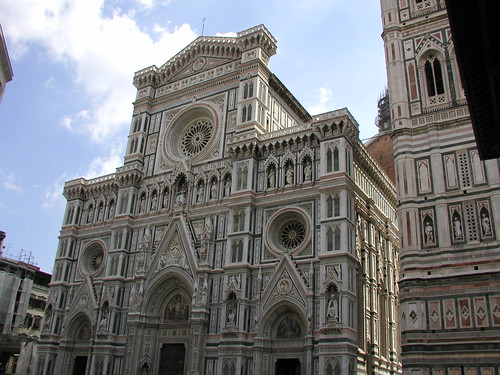
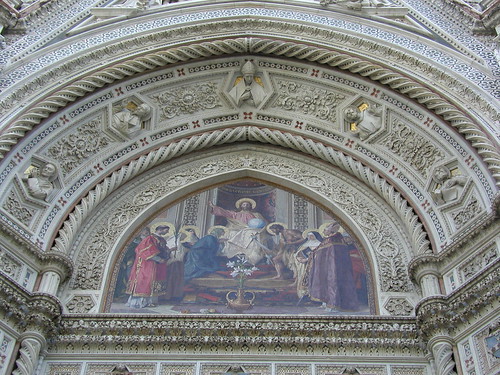
The facade of Santa Maria del Fiore - Every inch of the marble is either intricately carved or inlaid with green or pink marble accents. Up close, the elaborate carvings look like they're made from confectioner's icing and twisted sticks of hard-candy.
We started our day by checking out of our hotel and reclaiming our car so that we could stash our luggage in its trunk. Then we had to find a place to park the car, which took a while. After that, we set off on foot for the Piazza della Duomo. We stopped at a pastry shop along the way, and sat on a bench outside the church to eat our breakfast. When the gypsies and the Asian-scarf/shawl-vendor-ladies became too much of a nuisance, we decided to get in line. We weren't really sure what we were getting in line for, but that's what you do when you're a tourist in Italy... When you arrive at some famous, amazing site, you get in line. Sometimes it works out the way you were expecting, and sometimes it doesn't. I mention this because a couple of young Italian women approached us while we were in the line, and this is how the conversation went:
I'm not sure if she was asking, "Is this the line for tickets?" or "Do you know how much the tickets cost?" It didn't really matter. Even though they hadn't gotten any coherent answers, they shrugged, and got in line with the rest of us tourists, and we all wound up inside the church.
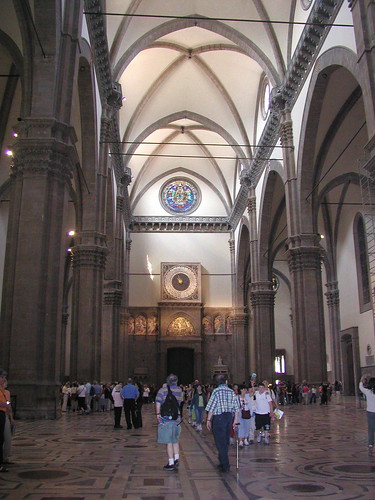
Interior of the church, facing toward the entrance.
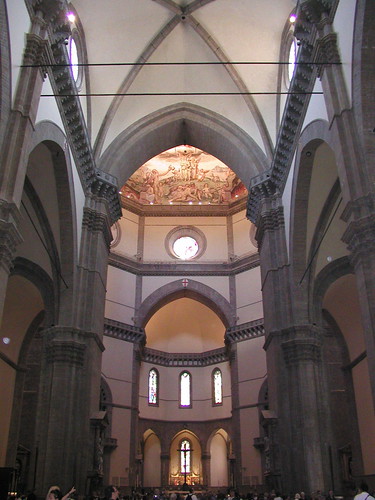
Interior of the church, facing toward the dome.
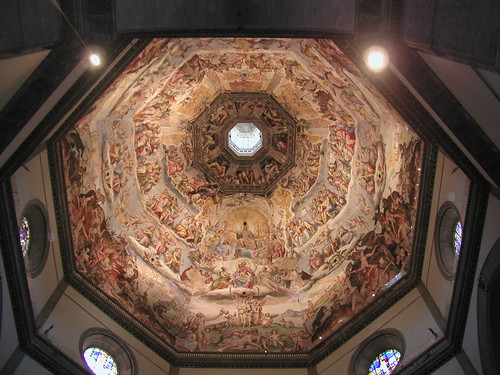
Interior of the dome.
As it turns out, admission to the church itself is free. You do, however, have to pay a fee of 6 Euros (and get in a different line) to go up into the dome. But it was well worth the price, even after factoring in the 463 steps to the top. The climb starts off with narrow stone stairs enclosed between stone walls. The straight staircases change to very tight spiral staircases, twisting upward inside the church walls and into the drum that supports the base of the dome. The drum has two walkways that overlook the interior of the church...
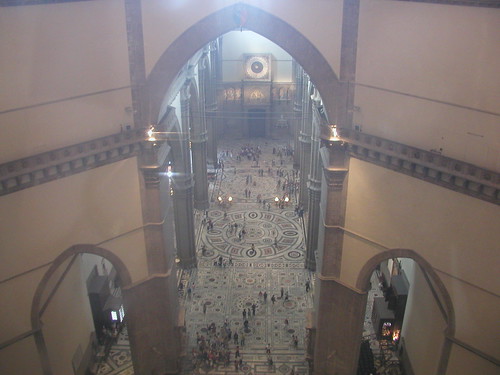
(Sorry about the glare-- They've got plexiglass up along the walkway (presumably so that people can't drop things) and the sunlight from the circular windows in the drum is reflecting off the plexiglass.)
There are actually two massive octagonal domes, with a hollow cavity between them. The lower dome is what you see from inside the church, and the outer dome is the roof that you see from the outside. Both domes were built in rings, without any framing or scaffolding, supporting their own weight as they grew upward. They are capped by a lantern (a tall cylinder with windows) which allows sunlight to illuminate the church through the top of the dome.
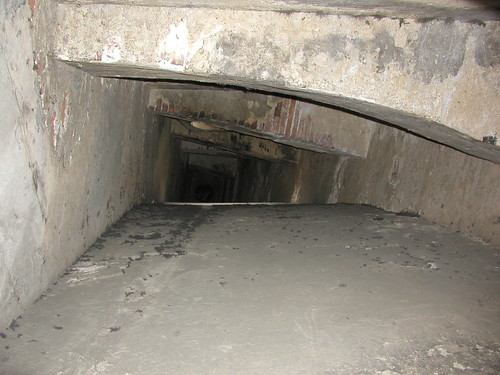
At the base of the dome, the steps become integrated into the surface of the inner dome. They follow a path tangent to the circumference of the dome, slanting at odd angles as they wind upward through the irregular cavity between the two domes. The last set of steps turn toward the center of the dome, climbing directly up the surface of the inner dome.
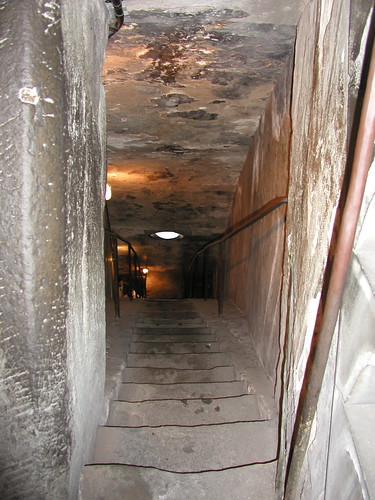
Finally, there is a stone ladder leading up through the outer dome, so that you escape the cave-like cavity and arrive, blinking in the glare of the sun, at the pinnacle of the dome. From the ledge surrounding the lantern you can see all of Florence stretched out below you, a lake of orange tiled roofs surrounded by the green hills of Tuscany.
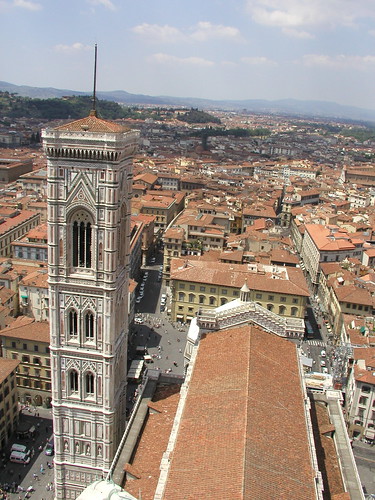
The dome was engineered by one man, Filippo Brunelleschi, and he also created several new types of construction equipment that were essential for building the dome. Like the Roman Forum & the Sistine Chapel, I became interested in seeing this landmark because of a book-- In this case, the book is Brunelleschi's Dome by Ross King, who is also the author of Michelangelo and the Pope's Ceiling. I highly recommend it to anyone who has any interest at all in architecture or engineering.
One of the things that I found interesting is that, during the Renaissance, Italians had a very low opinion of the "flying buttresses" prevalent elsewhere in Europe. They viewed the buttresses as a sort of ugly scaffolding technique. And actually, that's exactly what they are-- Well, ugly is up for debate, but they're definitely a structural crutch. The Gothic style was focused on bringing lots of natural light into buildings, primarily by creating high, vaulted ceilings and adding lots of windows. But high walls filled with windows would not have been strong enough to resist the outward thrust created by the arches that were used to construct the roofs, so flying buttresses were added to help provide extra resistance against that thrust. (As walls get taller, they also become less capable of resisting outward thrust.) While Italians did incorporate Gothic-style arches and windows into their churches, they resisted using flying buttresses, making their great churches significantly different from the cathedrals of England & France. (In this case, they did wind up having to implement a different sort of crutch. In the photos below, look for the black iron bars running across the vault. These tension members were added (per Brunelleschi's suggestion) after the main vault was completed, because the walls started to show signs of outward movement.)
Brunelleschi's challenge was to create a massive, octagonal, Gothic-arch-style dome that could be supported by the walls of the church. Fortunately, he happened to be a genius capable of the task, and so his dome still stands today, an architectural masterpiece in the heart of Florence.
The facade of Santa Maria del Fiore - Every inch of the marble is either intricately carved or inlaid with green or pink marble accents. Up close, the elaborate carvings look like they're made from confectioner's icing and twisted sticks of hard-candy.
We started our day by checking out of our hotel and reclaiming our car so that we could stash our luggage in its trunk. Then we had to find a place to park the car, which took a while. After that, we set off on foot for the Piazza della Duomo. We stopped at a pastry shop along the way, and sat on a bench outside the church to eat our breakfast. When the gypsies and the Asian-scarf/shawl-vendor-ladies became too much of a nuisance, we decided to get in line. We weren't really sure what we were getting in line for, but that's what you do when you're a tourist in Italy... When you arrive at some famous, amazing site, you get in line. Sometimes it works out the way you were expecting, and sometimes it doesn't. I mention this because a couple of young Italian women approached us while we were in the line, and this is how the conversation went:
Woman #1: "Parlate Italiano?"
Me: "No. Inglese."
Woman #1: *Something in Italian*
Me: *Shrug* "Sorry, I don't know."
Woman #1 to Woman #2: "Como dite i biglietti?"
Woman #2: "Tickets"
Woman #1 to Me: "Si. Tickets?"
Me: "I hope so!"
I'm not sure if she was asking, "Is this the line for tickets?" or "Do you know how much the tickets cost?" It didn't really matter. Even though they hadn't gotten any coherent answers, they shrugged, and got in line with the rest of us tourists, and we all wound up inside the church.
Interior of the church, facing toward the entrance.
Interior of the church, facing toward the dome.
Interior of the dome.
As it turns out, admission to the church itself is free. You do, however, have to pay a fee of 6 Euros (and get in a different line) to go up into the dome. But it was well worth the price, even after factoring in the 463 steps to the top. The climb starts off with narrow stone stairs enclosed between stone walls. The straight staircases change to very tight spiral staircases, twisting upward inside the church walls and into the drum that supports the base of the dome. The drum has two walkways that overlook the interior of the church...
(Sorry about the glare-- They've got plexiglass up along the walkway (presumably so that people can't drop things) and the sunlight from the circular windows in the drum is reflecting off the plexiglass.)
There are actually two massive octagonal domes, with a hollow cavity between them. The lower dome is what you see from inside the church, and the outer dome is the roof that you see from the outside. Both domes were built in rings, without any framing or scaffolding, supporting their own weight as they grew upward. They are capped by a lantern (a tall cylinder with windows) which allows sunlight to illuminate the church through the top of the dome.
At the base of the dome, the steps become integrated into the surface of the inner dome. They follow a path tangent to the circumference of the dome, slanting at odd angles as they wind upward through the irregular cavity between the two domes. The last set of steps turn toward the center of the dome, climbing directly up the surface of the inner dome.
Finally, there is a stone ladder leading up through the outer dome, so that you escape the cave-like cavity and arrive, blinking in the glare of the sun, at the pinnacle of the dome. From the ledge surrounding the lantern you can see all of Florence stretched out below you, a lake of orange tiled roofs surrounded by the green hills of Tuscany.
Tuesday, May 24, 2005
Roma to Firenze
We checked out of our hotel in Rome, took the train to the airport, and picked up our rental car. After a few minor detours, we wound up on the Via Cassia, on a quest for "a city on an island in the middle of a valley" called Bagnoregio. On our map of Italy, the city seemed to be near a large lake, so that description seemed to make sense, although we weren't able to find the city as we drove along the edge of the lake. It wasn't until we decided to start heading toward the A1 autostrada that it all became clear...
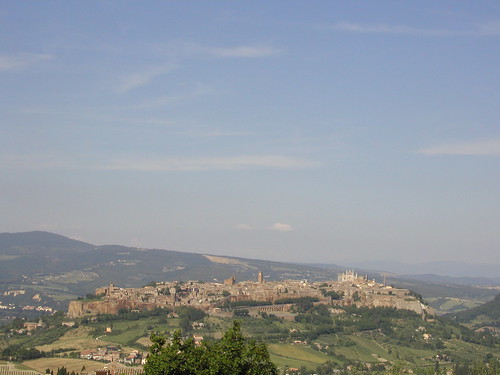
Bagnoregio is a walled city on a hill in the middle of a valley. Since we had a long drive still ahead of us, we decided not to back-track to see the city, but we stopped to have a snack and view it from a distance.
We continued on the A1 through Umbria and Tuscany to Florence. I had three small maps at Florence at my disposal, but none of them seemed to feel that street names would be at all relevant or helpful, so we wandered our way into the general area of town where I thought our hotel would be, and then we stopped and asked for directions at a little restaurant called Mr. Kebab. The guy behind the counter didn't recognize the name of the street that our hotel was on, but another woman in the restaurant did, and she said that we were very close-- less than three blocks away. She began giving me directions on how to walk there, but I told her that we had a car, and that changed everything. Sure, we were only three blocks away, but we literally couldn't get there from where we were. She indicated that we should drive south-west, away from the direction that the hotel was in, off the edge of the map, then turn north and go for several blocks until we hit a major street, then turn east and drive along the front of the old fortress for about a kilometer, then turn back south-west in the hope of getting to our hotel from that direction.
Florence is a rabbit warren of one-way alleys, all running off at acute angles, all partially clogged by parked cars, motorcycles, scooters, and bicycles. To make things more interesting, many of the piazzas are completely blocked off for cars, so the predominate mode of transportation is on two wheels-- mostly motorcyles & scooters, with an occasional bicycle. The main streets are perhaps the same width as a major six-lane road in the U.S., but there are no lane lines, and therefore no lanes of traffic, just a pile of cars maneuvering for position, with scooters and motorcycles swerving insanely in between. At a stop light, the flow of traffic resembles a landslide grinding to a halt, with cars tumbling into position like boulders, and scooters flowing into the cracks like smaller debris.
Needless to say, we wound up completely lost, and I was worried that someone was going to wind up dead-- either a scooter was going to get crunched by our car, or my husband was going to have an aneurysm. So we stopped and asked for directions again, this time from a Dutch or German guy who was walking his bike home and was extremely suspicious of approaching our car. We showed him where we wanted to be on our map, and he showed us where we actually were, and now those two spots were further apart than when we asked for directions the first time. While it was helpful to at least know where we were, he couldn't tell us how to get to our hotel, at least not by car.
We eventually figured it out and found our hotel, which wasn't exactly as advertised... It was in a old building which could have been quite nice, but the rooms were bleak at best, and there was no safe to put our valuables in while we went out to dinner, which wouldn't have been so bad if the door to the room had been secured by an actual lock system from the 20th century, instead of a skeleton key from the 1800's. There was also supposed to be a phone in our room, but when we asked at the desk, the guy told us that there was a pay phone outside on the street. (Maybe he guessed that the reason that we wanted the phone was so that we could make arrangements to check into our next hotel in Pescara a day early so that we wouldn't have to spend another night there!)
The hotel also advertised free parking, but they only meant that there was on-street parking available in front of the hotel. As we walked back from dinner, we became somewhat suspicious about the lack of cars on the street, so we studied the parking signs for clues. Based on my first French lessons from many, many years ago, I guessed that the signs were indicating that parking was not allowed on the street from midnight to 3am on Wednesday mornings, and it happened to be a Tuesday night. (I'm not sure what the Italian word for Wednesday is, but it resembles Mercredi, so there I am, thinking, "Lundi, Mardi, Mercredi... Oh, wait, I think the sign says Wednesday!") We checked with the guy behind the desk, and he confirmed that if we left the car there overnight it would certainly be towed, so we had to pay an extra 20 Euros to have someone from a garage come pick up the car and park if overnight.
And so we went to bed with not-so-fond feelings for Florence...
Bagnoregio is a walled city on a hill in the middle of a valley. Since we had a long drive still ahead of us, we decided not to back-track to see the city, but we stopped to have a snack and view it from a distance.
We continued on the A1 through Umbria and Tuscany to Florence. I had three small maps at Florence at my disposal, but none of them seemed to feel that street names would be at all relevant or helpful, so we wandered our way into the general area of town where I thought our hotel would be, and then we stopped and asked for directions at a little restaurant called Mr. Kebab. The guy behind the counter didn't recognize the name of the street that our hotel was on, but another woman in the restaurant did, and she said that we were very close-- less than three blocks away. She began giving me directions on how to walk there, but I told her that we had a car, and that changed everything. Sure, we were only three blocks away, but we literally couldn't get there from where we were. She indicated that we should drive south-west, away from the direction that the hotel was in, off the edge of the map, then turn north and go for several blocks until we hit a major street, then turn east and drive along the front of the old fortress for about a kilometer, then turn back south-west in the hope of getting to our hotel from that direction.
Florence is a rabbit warren of one-way alleys, all running off at acute angles, all partially clogged by parked cars, motorcycles, scooters, and bicycles. To make things more interesting, many of the piazzas are completely blocked off for cars, so the predominate mode of transportation is on two wheels-- mostly motorcyles & scooters, with an occasional bicycle. The main streets are perhaps the same width as a major six-lane road in the U.S., but there are no lane lines, and therefore no lanes of traffic, just a pile of cars maneuvering for position, with scooters and motorcycles swerving insanely in between. At a stop light, the flow of traffic resembles a landslide grinding to a halt, with cars tumbling into position like boulders, and scooters flowing into the cracks like smaller debris.
Needless to say, we wound up completely lost, and I was worried that someone was going to wind up dead-- either a scooter was going to get crunched by our car, or my husband was going to have an aneurysm. So we stopped and asked for directions again, this time from a Dutch or German guy who was walking his bike home and was extremely suspicious of approaching our car. We showed him where we wanted to be on our map, and he showed us where we actually were, and now those two spots were further apart than when we asked for directions the first time. While it was helpful to at least know where we were, he couldn't tell us how to get to our hotel, at least not by car.
We eventually figured it out and found our hotel, which wasn't exactly as advertised... It was in a old building which could have been quite nice, but the rooms were bleak at best, and there was no safe to put our valuables in while we went out to dinner, which wouldn't have been so bad if the door to the room had been secured by an actual lock system from the 20th century, instead of a skeleton key from the 1800's. There was also supposed to be a phone in our room, but when we asked at the desk, the guy told us that there was a pay phone outside on the street. (Maybe he guessed that the reason that we wanted the phone was so that we could make arrangements to check into our next hotel in Pescara a day early so that we wouldn't have to spend another night there!)
The hotel also advertised free parking, but they only meant that there was on-street parking available in front of the hotel. As we walked back from dinner, we became somewhat suspicious about the lack of cars on the street, so we studied the parking signs for clues. Based on my first French lessons from many, many years ago, I guessed that the signs were indicating that parking was not allowed on the street from midnight to 3am on Wednesday mornings, and it happened to be a Tuesday night. (I'm not sure what the Italian word for Wednesday is, but it resembles Mercredi, so there I am, thinking, "Lundi, Mardi, Mercredi... Oh, wait, I think the sign says Wednesday!") We checked with the guy behind the desk, and he confirmed that if we left the car there overnight it would certainly be towed, so we had to pay an extra 20 Euros to have someone from a garage come pick up the car and park if overnight.
And so we went to bed with not-so-fond feelings for Florence...
Monday, May 23, 2005
Vatican, Take II
We headed back to the Vatican again this morning, this time with a slightly better game plan. The guide who gave our tour through the Forum yesterday (Gastone) also conducts tours through the Vatican Museums, Sistine Chapel, and St. Peter's Basilica, so we got an early start to meet up with his group. It turned out to be a pretty good tour, although we didn't spend a whole lot of time in the Vatican Museums.
(To be fair though, there's no way you could even begin to see it all in one day, and honestly, I don't think we could have handled a much longer tour. The museums were really crowded, so there was a lot of shuffling and standing, which was hard on our (already tired) feet. And, since my husband and I both grew up in Ohio, (and not in say, Beijing, New York, or Rome, for example) we haven't developed a high tolerance for being bumped and jostled for hours on end.)
The line for the Vatican Museums stretched out for a couple of blocks around the city walls, and while we stood in the line, they passed out radios with headsets, so that Gastone could speak quietly into his microphone, and we didn't have to be clustered all around him in the museum. To keep us entertained, he gave a little background history on Michelangelo, Pope Julius, and the Sistine Chapel. (If you want to know why the Sistine Chapel is so acclaimed as a work of art, I recommend reading Michelangelo and the Pope's Ceiling by Ross King.)
Our tour took us through areas of the Museum dedicated to Renaissance art-- statues, tapestries, and paintings-- on the way to Raphael's rooms and the Sistine Chapel.
Raphael's fresco The School of Athens featuring great geniuses in philosophy, art, and science.
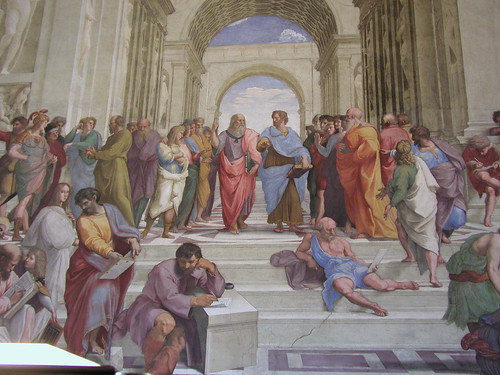
After seeing Michelangelo's work on the Sistine chapel, Raphael added a new figure to his work, front & center, beneath Plato & Aristotle. The "pensieroso" figure sitting by himself on the steps, writing, is supposed to represent Heraclitus of Ephesus, a solitary genius with a bitter temperament, but it is said to resemble Michelangelo, and people believe that Raphael added it to his work as a (grudging) tribute to Michelangelo.
The guards in the Sistine Chapel seem to get a kick out of enforcing all of the rules, which seem to be oriented around preventing you from appreciating Michelangelo's work... You can't sit down on the steps to look up at the ceiling, and you're also not allowed to stand in any one place for very long. Talking is strictly forbidden, even whispering. (But the guards continuously say "SHHH!" at 90 decibles, and they also come up behind people and clap loudly to make them move, because that's not distracting or annoying!) You are also not allowed to take photos or video, even without a flash. They say that 10,000 people a day go through the Sistine Chapel, so maybe it's unreasonable to expect that you could experience it in a relaxing environment.
St. Peter's Basilica is exactly what everyone says it is-- immense. I guess I had expected that it would be a reverent, awe-inspiring environment, but it's like most other places in Rome-- crowded and chaotic. Unfortunately, the idea that kept coming into my head as we stood in the basilica was the story of Jesus overturning the tables of the merchants in the Temple. While no one was selling anything, it just doesn't even remotely feel like a religious experience.
Don't get me wrong, I am glad that I got to see the Sistine Chapel and St. Peter's, but I don't think I would want to go back and see them again unless I knew they wouldn't be horribly crowded. I just don't know if that's ever possible!
Tomorrow we'll head back to the airport to pick up a rental car, and then we'll leave Rome for Florence. We're planning to make a day of it, taking the scenic route and maybe stopping in one or two of the smaller towns.
Ciao!
(To be fair though, there's no way you could even begin to see it all in one day, and honestly, I don't think we could have handled a much longer tour. The museums were really crowded, so there was a lot of shuffling and standing, which was hard on our (already tired) feet. And, since my husband and I both grew up in Ohio, (and not in say, Beijing, New York, or Rome, for example) we haven't developed a high tolerance for being bumped and jostled for hours on end.)
The line for the Vatican Museums stretched out for a couple of blocks around the city walls, and while we stood in the line, they passed out radios with headsets, so that Gastone could speak quietly into his microphone, and we didn't have to be clustered all around him in the museum. To keep us entertained, he gave a little background history on Michelangelo, Pope Julius, and the Sistine Chapel. (If you want to know why the Sistine Chapel is so acclaimed as a work of art, I recommend reading Michelangelo and the Pope's Ceiling by Ross King.)
Our tour took us through areas of the Museum dedicated to Renaissance art-- statues, tapestries, and paintings-- on the way to Raphael's rooms and the Sistine Chapel.
Raphael's fresco The School of Athens featuring great geniuses in philosophy, art, and science.
After seeing Michelangelo's work on the Sistine chapel, Raphael added a new figure to his work, front & center, beneath Plato & Aristotle. The "pensieroso" figure sitting by himself on the steps, writing, is supposed to represent Heraclitus of Ephesus, a solitary genius with a bitter temperament, but it is said to resemble Michelangelo, and people believe that Raphael added it to his work as a (grudging) tribute to Michelangelo.
The guards in the Sistine Chapel seem to get a kick out of enforcing all of the rules, which seem to be oriented around preventing you from appreciating Michelangelo's work... You can't sit down on the steps to look up at the ceiling, and you're also not allowed to stand in any one place for very long. Talking is strictly forbidden, even whispering. (But the guards continuously say "SHHH!" at 90 decibles, and they also come up behind people and clap loudly to make them move, because that's not distracting or annoying!) You are also not allowed to take photos or video, even without a flash. They say that 10,000 people a day go through the Sistine Chapel, so maybe it's unreasonable to expect that you could experience it in a relaxing environment.
St. Peter's Basilica is exactly what everyone says it is-- immense. I guess I had expected that it would be a reverent, awe-inspiring environment, but it's like most other places in Rome-- crowded and chaotic. Unfortunately, the idea that kept coming into my head as we stood in the basilica was the story of Jesus overturning the tables of the merchants in the Temple. While no one was selling anything, it just doesn't even remotely feel like a religious experience.
Don't get me wrong, I am glad that I got to see the Sistine Chapel and St. Peter's, but I don't think I would want to go back and see them again unless I knew they wouldn't be horribly crowded. I just don't know if that's ever possible!
Tomorrow we'll head back to the airport to pick up a rental car, and then we'll leave Rome for Florence. We're planning to make a day of it, taking the scenic route and maybe stopping in one or two of the smaller towns.
Ciao!
Subscribe to:
Posts (Atom)